1-800-24-RAFTS
All-Outdoors California Whitewater Rafiting

Real-Time Flow Reports for California Rivers

Last Modified on Thursday, May 3rd, 2012

Merced River Rafting

This page features real-time flow updates and helpful information about 10 of California's best whitewater rafting rivers.
The 2011-2012 "water year" started wet in fall and then turned dry in December. We had only one significant storm in late January and one smaller one in February. By the time we got to March 15, California had only received 30% of its normal precipitation. On the 16th of March everything started to shift when the storm door opened and eight strong, cold storm fronts rotated through until April 21 and left up to 20 feet of snow in the high Sierra! These late storms came just in time and have helped do some needed "catch-up" for the 2012 rafting season.

In addition to helpful storms, we had one of the wettest winters on record in 2011, and the leftover surplus of water means reservoirs will be at capacity and releasing adequate flows during the spring, summer, and fall of 2012.

For more details about winter's impact and spring's punch in the final round, read owner Gregg Armstrong's Flow Prediction blog.

This page gives you real-time and up-to-date flows so first check out the graph's "cold hard facts" and then read our analysis to perfect your understanding of California rivers.

To stay connected and up-to-date on all California river flow information, follow us on Twitter, Facebook, subscribe to the AO Blog or sign up for the AO eNews.

The measurement used to determine the flow in a river is “CFS”, which is Cubic Feet per Second. Gauges along the river indicate how much water is moving past a given point. The higher the “CFS” the higher the flow. Most of the time, higher flows (higher CFS) means more exciting and challenging rafting trips.

Click on your favorite California river below to see real-time water levels and season predictions!


BEGINNER - INTERMEDIATE INTERMEDIATE INTERMEDIATE -
ADVANCED
ADVANCED

South Fork American

Middle Fork American

Merced River

Tuolumne River

North Fork Stanislaus

Kaweah River

North Fork American

Goodwin Canyon

Cal Salmon

Cherry Creek


South Fork of the American River (Beginner - Intermediate / Class III+):

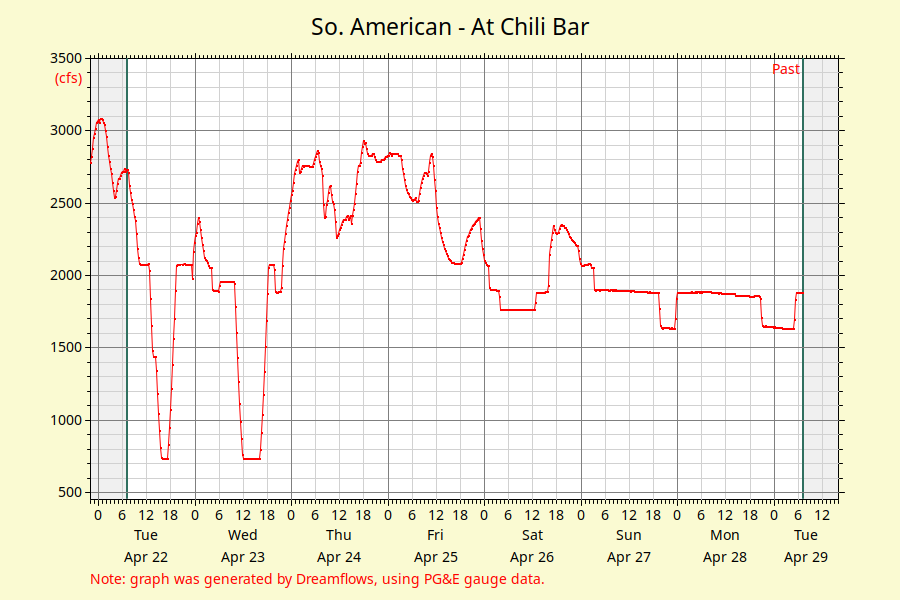
The South Fork of the American River is a classic "dam-controlled" river with six reservoirs above the whitewater section and runs year round due to the large amount of stored water. Reservoirs are full and will be releasing water regularly. The difference between this season and last season (a very wet year) is that High flows (5000-8000 CFS) will not occur in May. Flows ranging from 1300 to 3000 (Normal) will occur Friday-Tuesday, through May, and 1300 to 1700 six days a week during the summer months of June, July, and August (water is not guaranteed on Wednesdays). Normal flows will continue in September three days a week, Friday-Sunday, and on the weekends in October.

* When California has a low snowpack, the South Fork becomes one of our best whitewater rivers due to consistent flows, lots of rapids, and relatively low cost.

South Fork American Graph

1200 - 3000 CFS = Normal flows, usually associated with summer and fall. Plenty of fun Class II & III whitewater and beautiful scenery. Great flow for first timers, groups and families, yet still enjoyable for experienced boaters. Wetsuits only required during cooler months. Usual minimum age: 8 years and minimum weight 50 lbs.

3000 - 5000 CFS = Moderately-High flows. Challenging Class III+ whitewater, exciting for first timers and veterans alike. Big waves and swift moving water. Wetsuits usually required. Usual minimum age increased to 10 years.

5000 -8000 CFS = High flows. Challenging Class III+ whitewater. Fast moving water, with powerful waves and long rapids. Wetsuits required. Usual minimum age increased to 12 and 90 lbs.

Above 8000 CFS = Extreme flows. The river changes into an Intermediate Class IV river at these unusually high flows. Fast moving water, with powerful waves and long rapids. Wetsuits required. Trips at these flows are best for adventurous, athletic people who are not afraid of water. Usual minimum age increased to 15 years.


Middle Fork of the American (Intermediate / Class III - IV):

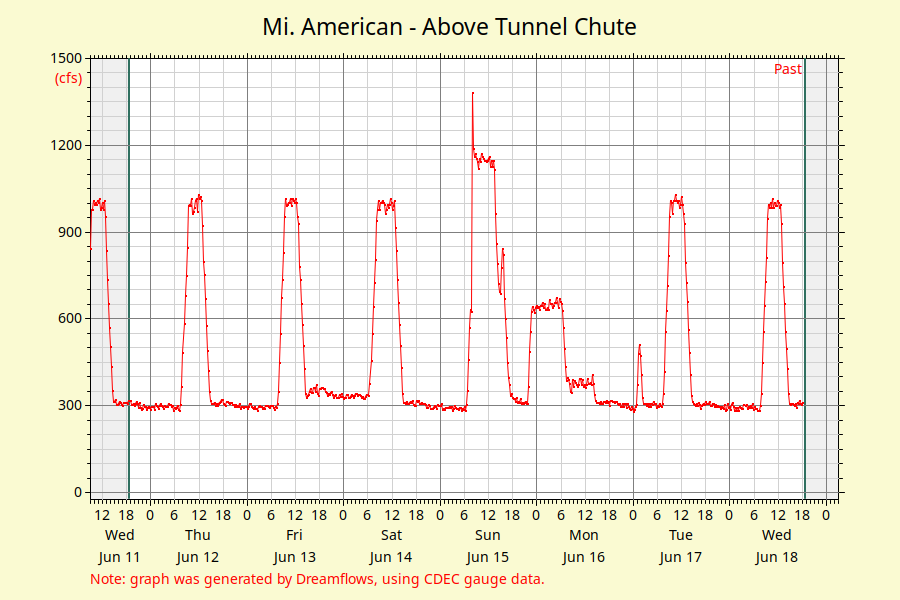
Due to two reservoirs above this run that will be at near capacity, flows on this beautiful river will occur seven days a week starting on May 5th and remain about 900 CFS through September. In early October the river will likely shut down for annual maintenance on the hydro electric project above the run.

* During dry years with less than normal precipitation in California, the Middle Fork becomes one of the best options for 1-, 2-, and 3-Day wilderness trips. Consistent flows released from the Oxbow PG&E Power House just above the run create a wonderful opportunity for Class III - IV rafting inside a 2000' deep scenic canyon.

Middle Fork American Graph

850 - 1300 CFS = Normal flows. Perfect for aggressive first timers or experienced paddlers. An excellent opportunity to experience Class IV whitewater while enjoying the stunning beauty of the Middle Fork canyon. Usual minimum age: 12 years old and 90 lbs.

1300 - 2000 CFS = Moderately-High flows. More challenging Class IV whitewater, yet suitable for a wide range of skill levels. Wetsuits may be required during cooler months. Usual minimum age may be increased.

2000 - 4000 CFS = High flows. Portages required around several major rapids. Trips are not usually offered during periods of high flows due to the number of portages.

Above 4000 CFS = Extreme flows. Not advisable


Merced River (Intermediate / Class III - IV):

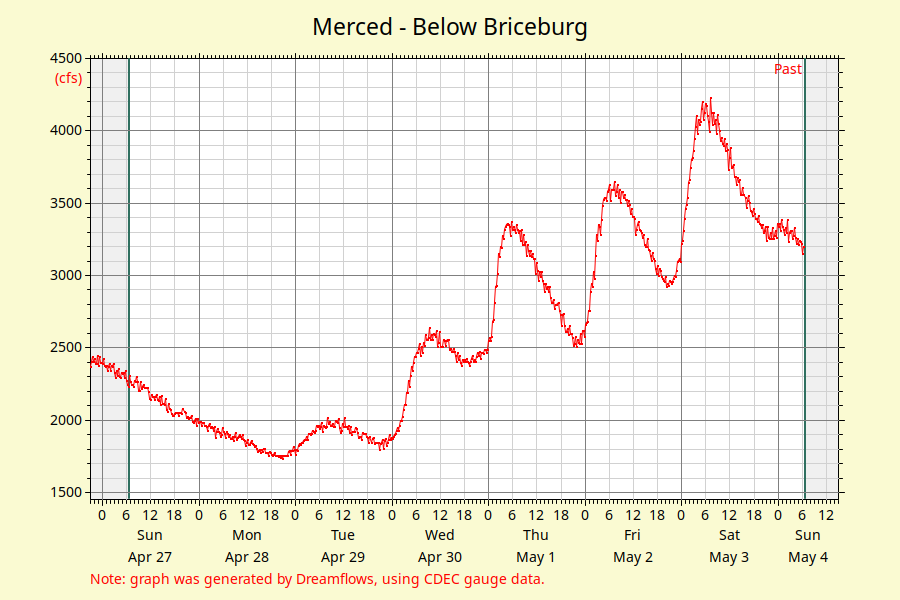
The Merced River is free-flowing and has no dams above the whitewater section. When winter snows begin to melt the Merced begins to run. Normally the river becomes runnable in April and continues through mid-July.This year the season will still begin in April, but will end earlier in mid-June, unless we get more storms in the next 6 weeks. If weather remains normal (no late cold storms), the season will consist of Normal flows (1500-4000 CFS) and experience some Lower flows (650-1000) toward the end of the season.

600 - 1500 CFS = Lower flows. Great for eager first timers and experienced rafters. Class III+ whitewater. Wetsuits only required during cooler months. Usual minimum age: 12 and 90 lbs.

1500 - 4000 CFS = Normal flows. Great for aggressive first timers and experienced rafters. Plenty of Class III & IV whitewater. Wetsuits required at higher flows and/or in cooler months.

4000 - 6000 CFS = Moderately-High flows. Challenging Class IV whitewater, exciting for experienced rafters. Bigger waves and swift moving water. Wetsuits required. Usual minimum age increased from 12 to 15 years.

6000 - 8000 CFS = High flows. Speed of the water picks up dramatically. Rapids lengthen and calms are shorter. Out of boat experiences (unplanned swims) become more challenging. Wetsuits required. Usual minimum age is 15 years.

Above 8000 CFS = Extreme flows. Big fast powerful moving water, with very large waves and long rapids. Calm stretches are very swift. Experience is highly recommended. Wetsuits required. Usual minimum age is 15 years.


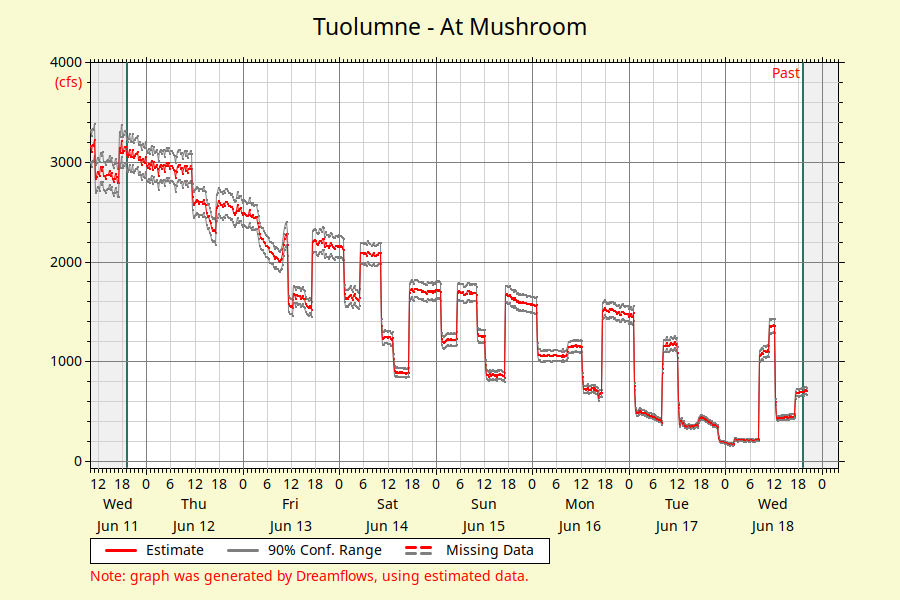
Tuolumne (Intermediate - Advanced / Class IV+):

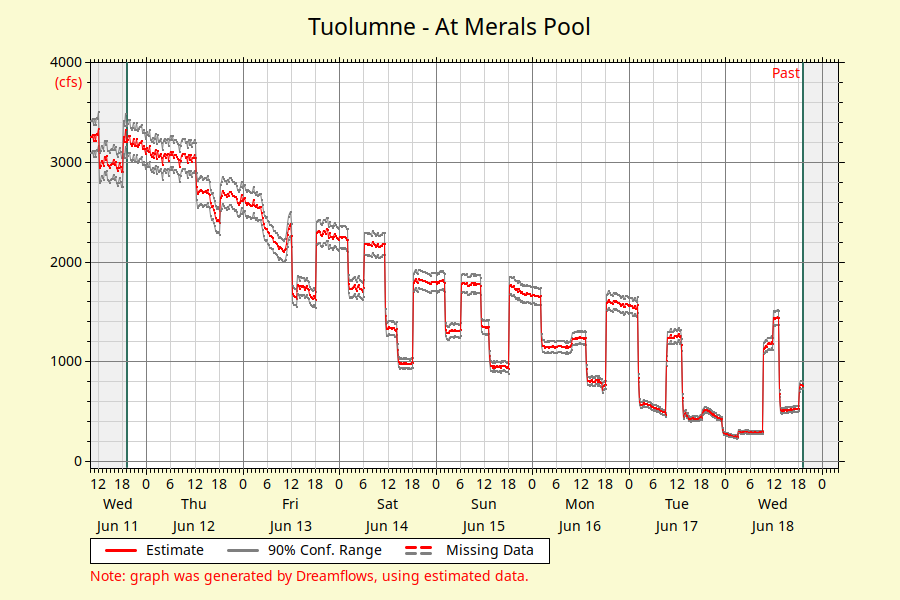
The Tuolumne is a dam-controlled river so it will have reliable flows through early September, due to water storage in upstream reservoirs. This river will have normal flows now through September 3. Beginning in June, every other Wednesday will not have guaranteed flows and after September 3rd, the river will shut down for annual hydro project maintenance and water conservation.

800 - 1200 CFS = Low flows. Technical rafting through smooth boulders above the water and smaller ones under the surface. Quick maneuvering and agile paddling required, as well as good balance and the ability to respond quickly to commands given by the guide. Rapids are abrupt and steep.

1200 - 3000 CFS = Normal flows. Great for aggressive first timers and experienced rafters. Plenty of Class III & IV whitewater. Wetsuits required during cooler months. Usual minimum age: 14 years old.

3000 - 5000 CFS = Moderately-High flows. Great for experienced rafters and a few aggressive first timers. Significant amount of Class III & IV+ whitewater. Wetsuits required during cooler months and higher flows. Usual minimum age may be increased to 15 years old.

5000 - 8000 CFS = High flows. Challenging Class IV+ whitewater, exciting for experienced rafters. Big waves and swift moving water. Wetsuits required. Usual minimum age increased to 15 years old.

Above 8000 CFS = Extreme flows. Fast moving water, with powerful waves and long rapids. Experience is highly recommended. Trips at these levels are best for very aggressive people who are not afraid of falling into a very fast river with long rapids. Wetsuits required. Usual minimum age may be increased.


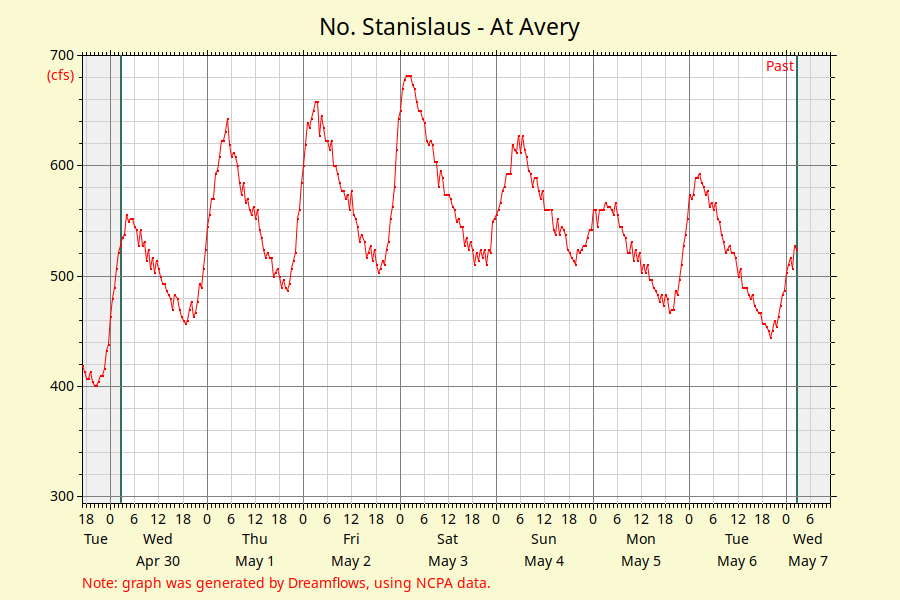
North Fork of the Stanislaus (Intermediate - Advanced / Class IV+):

The North Fork of the Stanislaus River acts like a free-flowing river, even though Spicer Reservoir is located 14 miles upstream at an elevation of 6300 feet. Melting snow below the reservoir feeds this beautiful river during spring. Usually the season is short, lasting from late April to late May. The cold storms from late March and early April have left snow at lower elevations that feed this beautiful Class IV+ run. The 2012 season will be short and sweet from April 21 to May 13.

flow chart for the North Fork Stanislaus

450 - 500 CFS = Low flows. Very technical rafting through boulders and narrow chutes. Many rapids start with blind turns and require quick and powerful maneuvers. Rapids and drops are abrupt and radical in regard to changes in elevation and speed. Boats remain light with 4 to 5 people per raft at the most.

500 - 700 CFS = Normal flows. Technical Class IV+ rafting through tight chutes, and over radical drops. At these flows the river resembles a trout stream at a high elevation complete with boulders, fallen trees and small pools. Wetsuits are required. Usual minimum age: 15 years old.

700 - 1000 CFS = Moderately-High flows. Less boulders and more drops. The river becomes more powerful and rapids increase in length. Plenty of Class IV+ whitewater. Wetsuits required.

1000 - 2000 CFS = High flows. Rapids become longer and more powerful and calms become very short. The obstacles change from boulders to stomping hydraulics and holes. Oar-paddle raft option may be utilized. Wetsuits required. Usual minimum age may be increased.

Above 2000 CFS = Extreme flows. Rapids begin to "link" with one another and become very challenging. Calms between the rapids become shorter and some disappear. Wetsuits required. Usual minimum age will be increased.


Kaweah (Intermediate - Advanced / Class IV+):

The Kaweah is a free-flowing river with no dams above the whitewater section. At this time there is not enough snow in the southern part of the Sierra to create a predictable and sustainable rafting season. If we are fortunate enough to get large, cold storms in the southern part of the Sierra that leave 3-4 feet of snow, the Kaweah season will be resurrected and could run through the month of May and longer, depending on the amount of snow.

Kaweah River Graph

700 - 1200 CFS = Low flows. Technical rafting through boulder filled rapids and narrow exciting passages. Drops are abrupt, sharp and involve significant changes in elevation. Good balance and the ability to respond to commands quickly and paddle hard are necessary.

1200 - 1800 CFS = Normal flows. Challenging Class IV+ whitewater. These flows are most appropriate for aggressive and experienced rafters. The river is filled with big waves and long rapids with very short calms in between. Wetsuits often required.

1800 - 3000 CFS = Moderately-High flows. Fast moving water with powerful waves and very long rapids. Wetsuits required. Possibility of falling out of the raft and swimming in a rapid is good. Usual minimum age may be increased.

3000 - 4000 CFS = High flows. Fast moving water with powerful waves and very long rapids. Wetsuits required. Oar-Paddle Combo rafts used most often. Only for aggressive, athletic people, who are not afraid of swimming in turbulent water. Usual minimum age will be increased.

Above 4000 CFS = Extreme flows. Very long rapids with very short, even non existent calms. Boulders are replaced by big pour-overs where water plunges downward into turbulent, violent water. Trips at these high flows are not for the faint hearted. The river rarely gets to these levels.


North Fork of the American (Intermediate - Advanced / Class IV+):

The North Fork is a free-flowing river and runs only in the spring when the winter snowpack begins to melt. It has a relatively low and small drainage so the season is shorter than other rivers and usually only lasts until the middle or end of May. In 2012, the North Fork will have Normal flows (1000-2000 CFS), until mid-May,, unless more storms roll into California in the next few weeks.

For real time flow information, click here.

600 - 1200 CFS = Low flows. Forgiving Class IV whitewater. Best for experienced rafters who like the challenge of difficult paddling and maneuvers. Wetsuits only required during cooler months. Usual minimum age: 15 years old.

1200 - 1800 CFS = Normal flows. Challenging Class IV+ whitewater, exciting for veterans. Previous experience preferred and helpful. Bigger waves and swift moving water. Wetsuits required.

1800 - 2200 CFS = Moderately-High flows. Challenging Class IV+ whitewater, fast moving water, with powerful waves and long rapids. Calms between rapids are short and swift. Participants should be athletic individuals with previous experience. Wetsuits required. Usual minimum age may be increased.

2200 - 3500 CFS = High flows. Very challenging Class IV+ whitewater with some Class V rapids. Very fast moving water, with powerful waves and rapids that "link" together. Participants should be very aggressive and athletic individuals with previous experience, and not afraid of falling into the river and swimming through very turbulent water. Wetsuits required. Usual minimum age will be increased.

3500 CFS = Extreme flows. The North Fork rarely gets to these flows due to the small drainage and relatively low elevation of melting snows. When the river reaches these levels it changes character and becomes a "pin ball" type run with water bouncing off the walls of its narrow canyon. Rapids become very challenging and the river itself very swift. Experienced rafters are best suited for trips at these flows. Wetsuits required. Usual minimum age will be increased.


Goodwin Canyon / Stanislaus River (Intermediate - Advanced / Class IV+):

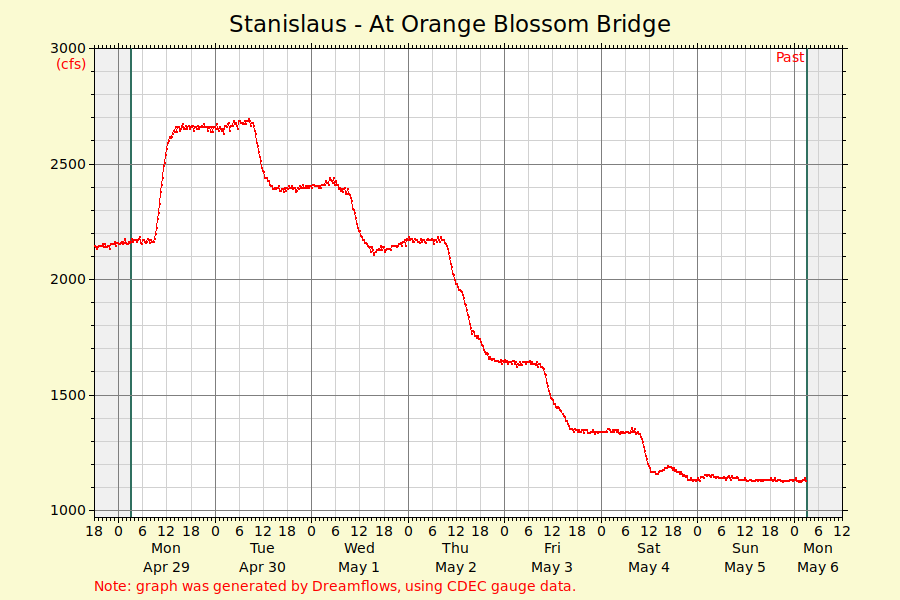
The Goodwin Canyon section of the Stanislaus River is a dam-controlled river. During the summer time, most of the water from upstream reservoir is diverted into large canals just before the whitewater section. These canals bring water to farmers in the San Joaquin Valley. During April and May water released to the river is increased to help young salmon make their first trip down stream and under the Golden Gate to the ocean where they can grow for several years before returning to Goodwin Canyon to spawn. This additional water creates excellent rafting conditions. In October water releases are increased again for two weeks to allow salmon to return for spawning. In years of heavy winter snowfall when excess water is available, water is released all spring and summer and into fall to help the salmon fishery and desalination of the Delta (this occurred in 2011).

In 2012, releases of 1000-2000 CFS (Normal to Moderately High) began in April and will end on May 24th. The fall releases will begin on October 17 and end October 29th, and will be very similar. Be sure to read about our Goodwin Canyon Days that occur each fall.

Goodwin Canyon Graph

500 - 700 CFS = Low flows. Very technical rafting through boulders and narrow chutes. Many rapids require quick and powerful maneuvers. Rapids and drops are abrupt and radical in regard to changes in elevation and speed. Boats remain light with 4 to 6 people per raft at the most.

700 - 1500 CFS = Normal flows. Technical Class IV+ rafting through tight chutes, and over radical drops. At these flows the river moves slower in the calms but very quick through the drops. Usual minimum age: 15 years old.

1500 - 2000 CFS = Moderately-High flows. Less boulders inside the drops. More powerful hydraulics and large impressive waves. More boulders are covered up with water eliminating some obstacles and creating more holes to thrill or avoid. Several Class IV+ rapids are approaching Class V.

2000 - 3000 CFS = High flows. Rapids remain the same length but become even more powerful. Calms are swift. The obstacles change from boulders to stomping hydraulics and holes. Usual minimum age may be increased.

Above 3000 CFS = Extreme flows. Rapids are intimidating. The possibility of unplanned swims and upside down rafts more likely. Usual minimum age will be increased.


Cal Salmon (Advanced / Class V):

The Cal Salmon is a free-flowing river and usually only runs in the spring when the winter snowpack is melting. At this time Northern California has received more rain and snow than the rest of the State, and is at 100% of normal. The river will have Normal to High flows which will occur from now through June.

For real time flow information, click here.

1000 - 1400 CFS = Low flows. Forgiving Class IV and some Class V whitewater. Best for experienced rafters who like the challenge of difficult paddling and maneuvers. Wetsuits only required during cooler months. Usual minimum age: 15 years old.

1400 - 3000 CFS = Normal flows. Challenging Class IV+ and Class V whitewater, exciting for veterans. Previous experience preferred and helpful. Bigger waves and swift moving water. Wetsuits required.

3000 - 4000 CFS = Moderately-High flows. Challenging Class V whitewater, fast moving water, with powerful waves and long rapids. Calms between rapids are short and swift. Participants should be athletic individuals with previous experience. Wetsuits required. Usual minimum age may be increased.

4000-5000 CFS = High flows. Very challenging Class V whitewater. Fast moving water, with powerful waves and rapids with large hydraulics and difficult maneuvers. Participants should be very aggressive and athletic individuals with previous experience, and should not be afraid of falling into the river and swimming through very turbulent water. Wetsuits required. Usual minimum age will be increased.

Above 5000 CFS = Extreme flows. The river does not reach these high flows very often. When it does it is wild. The canyon is narrow so at high flows the water rushes through the canyon at high speeds. Rapids become long and very challenging and powerful. Swims are difficult. Anyone involved in trips at these levels must be physically fit, a good swimmer, and an experienced rafter.


Cherry Creek (Advanced / Class V+):

Cherry Creek is the upper stretch of the Tuolumne River and considered the most difficult commercial rafting trip in the U.S. In most years, the river runs too high in spring and early summer. In low snowpack years, the Cherry Creek season begins earlier as soon as the flows drop below 2000 CFS. This year this will likely happen in early June, so 2012 may turn out to be one of the best Cherry Creek seasons ever! These ideal flows will continue through September 3, when water releases from upstream reservoirs become inadequate (too low) for Class V rafting.

Real-Time Flows for Cherry Creek

1000 - 1500 CFS = Medium flows. Challenging Class V+ whitewater, exciting for veterans. Previous experience needed. Big drops over and around huge boulders mean quick maneuvering around powerful obstacles. Difficult and long swims are possible should someone fall out of the raft. Wetsuits required. Usual minimum age: 18 years old.

1500 - 2200 CFS = High flows. Very challenging Class V+ whitewater, with powerful and fast moving water. Rapids consist of big drops into giant holes with very turbulent water. Calms between rapids are short and swift. Participants should be very athletic and aggressive and have previous Class IV+ rafting experience. Wetsuits required.


Home :: California Rivers :: Contact Us :: Employment :: FAQs :: Discounts :: Pricing :: River Flows :: AO Blog :: Sitemap
Maps & Travel Details :: American River Rafting :: About All-Outdoors :: Reviews & Feedback :: Rafting Videos
Trip Planning :: Reservation Info :: Custom Trips :: Premium Upgrades :: River Weddings


2011 © All-Outdoors California Whitewater Rafting